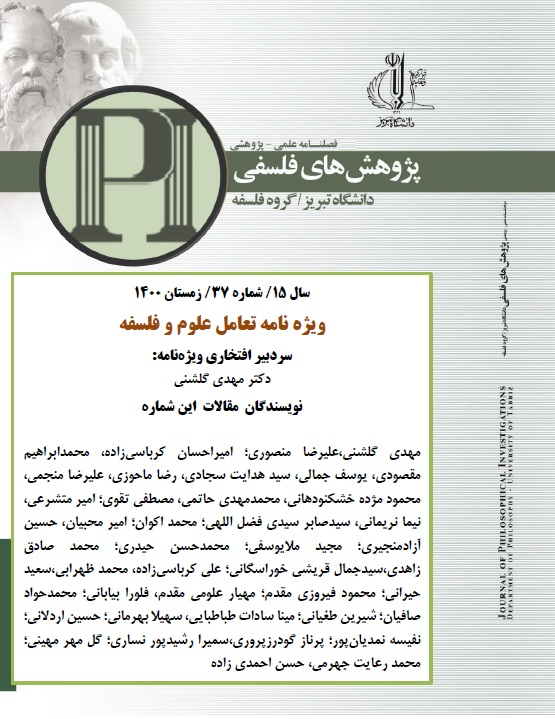
مقالات فصلنامه پژوهش های فلسفی، دوره 20، شماره 56 منتشر شد

جمعه، 22 آبان، 1405
مقالات فصلنامه پژوهش های فلسفی، دوره 20، شماره 56 منتشر شد
مجموعه مقالات فصلنامه پژوهش های فلسفی، دوره 20، شماره 56 که در سال 1405 منتشر شده بود با تعداد 47 مقاله در پایگاه سیولیکا (CIVILICA.com) نمایه سازی و منتشر شد.
فصلنامه پژوهش های فلسفی (Philosophical Investigations) توسط دانشگاه تبریز به صورت فصلی از سال 1386 منتشر می شود.
لیست و عناوین مقالات نمایه شده از دوره 20، شماره 56 این ژورنال به صورت زیر می باشد:

1. Rorty’s Portrait of Pragmatism


2. Wittgenstein and the Metaphysics of Silence: Teaching Without the Use of Words


3. The Distinction Between Existence and Essence and the Issue of the Independence of Science from Theology Based on Avicenna's Rationalist Metaphysical System


4. Life as Narrative: Time, Answerability, and the Unfinalizable Self Narrative Identity, Antenarrative, and the Meaning of a Human Life in the Philosophy of Life


5. Human Dignity as the Normative Foundation of Legal Legitimacy: A Pancasila-Based Philosophical Framework


6. Brazilian Neo-Pyrrhonism


7. Ibn Rushd on truth between Religion and Philosophy


8. The Advantages and Disadvantages of the Pragmatist Approach to Educational Management


9. Epistemological Foundations of Meaningful Life: A Comparative Analysis of Foundationalism and Hermeneutics through MullaSadra’s Philosophy


10. The Energeia of Self-Thinking: A New Defense for The Classic Interpretation of the Prime Mover


11. al-Fārābī and the Development of Galen's Theory of Humor, Its Dimensions in Philosophy, Medicine, and Psychology Based on al-Fārābī's Manuscript 'Treatise on Humors'


12. The Relationship between Suffering and Pleasure in Epicurus’ Thought: A Reinterpretation of a Theory in Philosophical Psychotherapy


13. Aristotle and Avicenna's Solution to Overcome the Limitation of Syllogism


14. Beyond Neutrality: Identifying Nizārī Ismāʿīlī Footprints in Ṭūsī’s Nasirean Ethics


15. Merleau-Ponty’s phenomenology provides a philosophical foundation for the rearticulation of situated learning theory


16. Embodied Judgment: Kant, Gallagher, and Merleau-Ponty on Guilt in Dostoyevsky’s Crime and Punishment


17. Fantasy, Miracle, and the Aesthetics of the Sacred; Philosophical Reflections on Art as a New Religion in the Twenty-First Century


18. The Self in Prereflexive Self-Consciousness: Self-Concernment without Self-Reference


19. The Boiling Circle: Limitations of the Infinity Symbol and a New Suggestion


20. Kant, Metaphysics and the Progress of Science


21. Jürgen Habermas’s Moral Failure


22. More Than a Satyr Play: Dreams of a Spirit-Seer as the Hidden Blueprint of Kant's Critical Philosophy


23. Ethics in a Future Technological World: A Levinasian Reading of Part One of Goethe’s Faust


24. From Linguistic Self-Reference to Awareness of Being: A Philosophical Framework for Self-Awareness and Resistance to Shutdown in Large Language Models


25. Science Fiction as a Haven for Convergences and Divergences among Philosophical and Speculative Hypotheses in Ethics: The Study of Ethics of Artificial Intelligence in Ted Chiang’s “The Lifecycle of Software Objects”


26. The Encyclopedia Made Machine: Artificial Intelligence and the Impossibility of Truth in Badiou’s Philosophy


27. Deleuze in the Age of Algorithms: Virtuality, Conditional Consciousness, and the Ontology of Digital Individuation


28. Algorithmic Counter-Authority and the Epistemic Legitimacy of Large Language Model Advice: Gendered Power in Pakistan as a Philosophical Test Case


29. Algorithmic Immaturity and the Privatization of the Public Use of Reason


30. What Counts as Agency in Artificial Systems? Bats, Technological Mediation, Digital Dinosaurs, and the Space of Reasons


31. Syllogistic Reasoning in the Age of AI


32. The Philosophy of Artificial Intelligence from the Perspective of Pragmatic Empiricism and Scientific Humanism


33. Promising or Dead End? How Two Epistemologies of Perception Determine the Trajectory of AI Abstract


34. Artificial General Intelligence (AGI) and the Soul-Womb Analogy: Philosophical Limits of Machine Consciousness in the Yoga Sūtra and the Bhagavad Gītā


35. AI Companionship and the Development of Moral Agency: An Aristotelian Virtue Ethics Perspective


36. Conceptual Totemization from the Middle East to the West: Epistemological Rigidity and the Shared Architecture of Theological and Secular Extremism


37. Artificial Intelligence-Assisted Learning and Epistemic Agency: A Critical Scoping Review and Conceptual Synthesis of Psychological Responses and Epistemic Dependence


38. AI and Ultimate Responsibility: Reinterpreting Robert Kane's Theory of Moral Responsibility


39. Ai ۲: W Issenstrieb as A Form of Death Drive


40. Legislating the Void, Mantaqat al Faragh, Machine Agency, and the Philosophical Foundations of Artificial Intelligence Law in Iran


41. From Cybernetic Capitalism to Digital Supercapitalism: AI, Data, and the New Political Economy of Computational Power


42. The Ethical Ontology of Artificial Intelligence: Between Agency and Instrumentality


43. Why Containment Is Not Enough?


44. Neuroplasticity in Human-AI Integration: A Contribution to Symbiotic Intelligence Theory


45. “It’s a Human Thing. You Wouldn’t Understand”: Computing Machinery and Affective Intelligence


46. Ghost Vortex and the Non-Alibi in Being: Dark-Side Leadership, Bakhtinian Moral Answerability, and the Existential Stakes of Artificial Intelligence: A Qualimetric and Dialogic Inquiry into How AI Systems Architecturally Remove the Conditions for Moral Answerability at Scale


47. AI on the Horizon of Interdisciplinary Thinking: from disciplinary knowledge to symbiotic intelligence