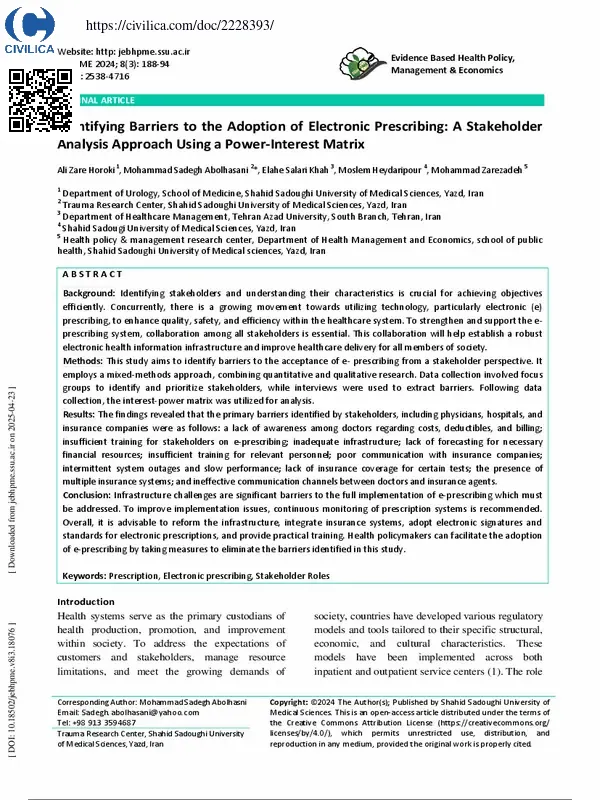
Identifying Barriers to the Adoption of Electronic Prescribing: A Stakeholder Analysis Approach Using a Power-Interest Matrix
سال انتشار: 1403
نوع سند: مقاله ژورنالی
زبان: انگلیسی
مشاهده: 151
فایل این مقاله در 7 صفحه با فرمت PDF قابل دریافت می باشد
- صدور گواهی نمایه سازی
- من نویسنده این مقاله هستم
استخراج به نرم افزارهای پژوهشی:
شناسه ملی سند علمی:
JR_EBHPME-8-3_005
تاریخ نمایه سازی: 3 اردیبهشت 1404
چکیده مقاله:
Background: Identifying stakeholders and understanding their characteristics is crucial for achieving objectives efficiently. Concurrently, there is a growing movement towards utilizing technology, particularly electronic (e) prescribing, to enhance quality, safety, and efficiency within the healthcare system. To strengthen and support the e-prescribing system, collaboration among all stakeholders is essential. This collaboration will help establish a robust electronic health information infrastructure and improve healthcare delivery for all members of society.
Methods: This study aims to identify barriers to the acceptance of e- prescribing from a stakeholder perspective. It employs a mixed-methods approach, combining quantitative and qualitative research. Data collection involved focus groups to identify and prioritize stakeholders, while interviews were used to extract barriers. Following data collection, the interest-power matrix was utilized for analysis.
Results: The findings revealed that the primary barriers identified by stakeholders, including physicians, hospitals, and insurance companies were as follows: a lack of awareness among doctors regarding costs, deductibles, and billing; insufficient training for stakeholders on e-prescribing; inadequate infrastructure; lack of forecasting for necessary financial resources; insufficient training for relevant personnel; poor communication with insurance companies; intermittent system outages and slow performance; lack of insurance coverage for certain tests; the presence of multiple insurance systems; and ineffective communication channels between doctors and insurance agents.
Conclusion: Infrastructure challenges are significant barriers to the full implementation of e-prescribing which must be addressed. To improve implementation issues, continuous monitoring of prescription systems is recommended. Overall, it is advisable to reform the infrastructure, integrate insurance systems, adopt electronic signatures and standards for electronic prescriptions, and provide practical training. Health policymakers can facilitate the adoption of e-prescribing by taking measures to eliminate the barriers identified in this study.
کلیدواژه ها:
نویسندگان
Ali Zare Horoki
Department of Urology, School of Medicine, Shahid Sadoughi University of Medical Sciences, Yazd, Iran
Mohammad Sadegh Abolhasani
Shahid Rahnemoon Hospital, Shahid Sadoughi University of Medical Sciences, Yazd, Iran
Elahe Salari Khah
Department of Healthcare Management, Tehran Azad University, South Branch, Tehran, Iran
Moslem Heydaripour
Shahid Sadougi University of Medical Sciences, Yazd, Iran
Mohammad Zarezadeh
Department of Health Care Management, Health Management and Policy Research Center , School of Public Health, Shahid Sadougi University of Medical Sciences, Yazd, Iran
مراجع و منابع این مقاله:
لیست زیر مراجع و منابع استفاده شده در این مقاله را نمایش می دهد. این مراجع به صورت کاملا ماشینی و بر اساس هوش مصنوعی استخراج شده اند و لذا ممکن است دارای اشکالاتی باشند که به مرور زمان دقت استخراج این محتوا افزایش می یابد. مراجعی که مقالات مربوط به آنها در سیویلیکا نمایه شده و پیدا شده اند، به خود مقاله لینک شده اند :