Changes in CA۱۲۵ and CA۱۹-۹ Biomarkers and Lesion Size in Deep Infiltrating Endometriosis Patients Treated with Dienogest

سال انتشار: 1405
نوع سند: مقاله ژورنالی
زبان: انگلیسی
مشاهده: 65

فایل این مقاله در 7 صفحه با فرمت PDF قابل دریافت می باشد

استخراج به نرم افزارهای پژوهشی:

لینک ثابت به این مقاله:

شناسه ملی سند علمی:

JR_JOGCR-11-9_005

تاریخ نمایه سازی: 14 مرداد 1405

چکیده مقاله:

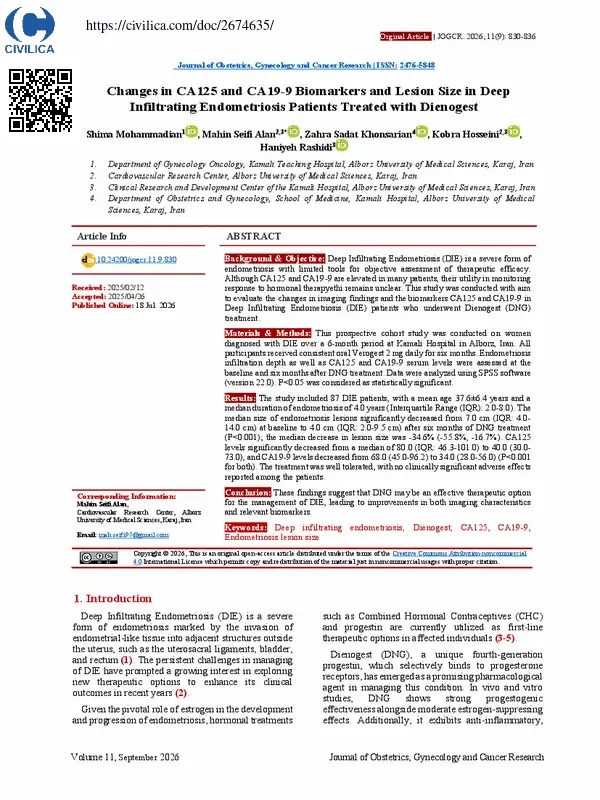
Background & Objective: Deep Infiltrating Endometriosis (DIE) is a severe form of endometriosis with limited tools for objective assessment of therapeutic efficacy. Although CA۱۲۵ and CA۱۹‑۹ are elevated in many patients, their utility in monitoring response to hormonal therapyethi remains unclear. This study was conducted with aim to evaluate the changes in imaging findings and the biomarkers CA۱۲۵ and CA۱۹-۹ in Deep Infiltrating Endometriosis (DIE) patients who underwent Dienogest (DNG) treatment. Materials & Methods: This prospective cohort study was conducted on women diagnosed with DIE over a ۶-month period at Kamali Hospital in Alborz, Iran. All participants received consistent oral Verogest ۲ mg daily for six months. Endometriosis infiltration depth as well as CA۱۲۵ and CA۱۹-۹ serum levels were assessed at the baseline and six months after DNG treatment. Data were analyzed using SPSS software (version ۲۲.۰). P<۰.۰۵ was considered as statistically significant. Results: The study included ۸۷ DIE patients, with a mean age ۳۷.۶±۶.۴ years and a median duration of endometriosis of ۴.۰ years (Interquartile Range (IQR): ۲.۰-۸.۰). The median size of endometriosis lesions significantly decreased from ۷.۰ cm (IQR: ۴.۰-۱۴.۰ cm) at baseline to ۴.۰ cm (IQR: ۲.۰-۹.۵ cm) after six months of DNG treatment (P<۰.۰۰۱); the median decrease in lesion size was -۳۴.۶% (-۵۵.۸%, -۱۶.۷%). CA۱۲۵ levels significantly decreased from a median of ۸۰.۰ (IQR: ۴۶.۳-۱۰۱.۰) to ۴۰.۰ (۳۰.۰-۷۳.۰), and CA۱۹-۹ levels decreased from ۶۸.۰ (۴۵.۰-۹۶.۲) to ۳۴.۰ (۲۸.۰-۵۶.۰) (P<۰.۰۰۱ for both). The treatment was well tolerated, with no clinically significant adverse effects reported among the patients. Conclusion: These findings suggest that DNG may be an effective therapeutic option for the management of DIE, leading to improvements in both imaging characteristics and relevant biomarkers.

نویسندگان

Shima Mohammadian

Department of Gynecology Oncology, Kamali Teaching Hospital, Alborz University of Medical Sciences, Karaj, Iran

Mahin Seifi Alan

Clinical Research and Development Center of the Kamali Hospital, Alborz University of Medical Sciences, Karaj, Iran

Zahra Sadat Khonsarian

Department of Obstetrics and Gynecology, School of Medicine, Kamali Hospital, Alborz University of Medical Sciences, Karaj, Iran

Kobra Hosseini

Clinical Research and Development Center of the Kamali Hospital, Alborz University of Medical Sciences, Karaj, Iran

Haniyeh Rashidi

Clinical Research and Development Center of the Kamali Hospital, Alborz University of Medical Sciences, Karaj, Iran

مراجع و منابع این مقاله:
لیست زیر مراجع و منابع استفاده شده در این مقاله را نمایش می دهد. این مراجع به صورت کاملا ماشینی و بر اساس هوش مصنوعی استخراج شده اند و لذا ممکن است دارای اشکالاتی باشند که به مرور زمان دقت استخراج این محتوا افزایش می یابد. مراجعی که مقالات مربوط به آنها در سیویلیکا نمایه شده و پیدا شده اند، به خود مقاله لینک شده اند :