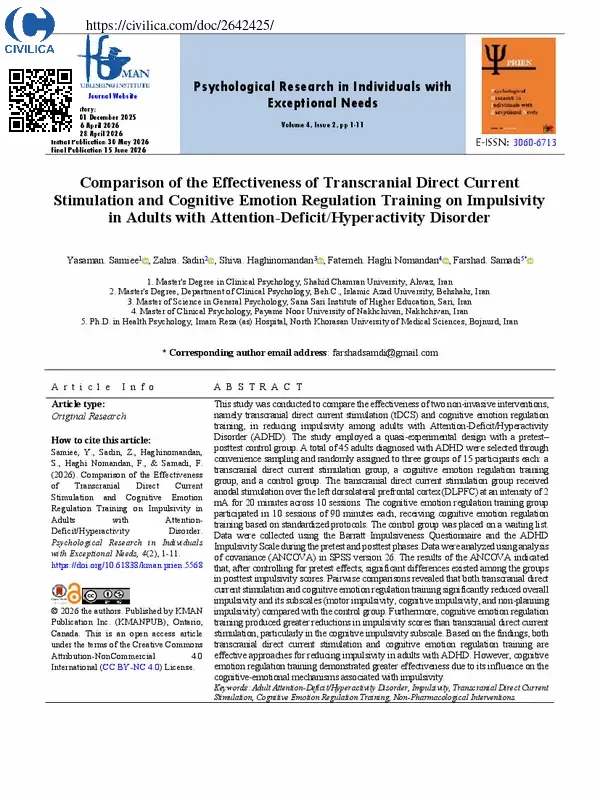
Comparison of the Effectiveness of Transcranial Direct Current Stimulation and Cognitive Emotion Regulation Training on Impulsivity in Adults with Attention-Deficit/Hyperactivity Disorder
سال انتشار: 1405
نوع سند: مقاله ژورنالی
زبان: انگلیسی
مشاهده: 142
فایل این مقاله در 11 صفحه با فرمت PDF قابل دریافت می باشد
- صدور گواهی نمایه سازی
- من نویسنده این مقاله هستم
استخراج به نرم افزارهای پژوهشی:
شناسه ملی سند علمی:
JR_PRIEN-4-2_006
تاریخ نمایه سازی: 1 تیر 1405
چکیده مقاله:
This study was conducted to compare the effectiveness of two non-invasive interventions, namely transcranial direct current stimulation (tDCS) and cognitive emotion regulation training, in reducing impulsivity among adults with Attention-Deficit/Hyperactivity Disorder (ADHD). The study employed a quasi-experimental design with a pretest–posttest control group. A total of ۴۵ adults diagnosed with ADHD were selected through convenience sampling and randomly assigned to three groups of ۱۵ participants each: a transcranial direct current stimulation group, a cognitive emotion regulation training group, and a control group. The transcranial direct current stimulation group received anodal stimulation over the left dorsolateral prefrontal cortex (DLPFC) at an intensity of ۲ mA for ۲۰ minutes across ۱۰ sessions. The cognitive emotion regulation training group participated in ۱۰ sessions of ۹۰ minutes each, receiving cognitive emotion regulation training based on standardized protocols. The control group was placed on a waiting list. Data were collected using the Barratt Impulsiveness Questionnaire and the ADHD Impulsivity Scale during the pretest and posttest phases. Data were analyzed using analysis of covariance (ANCOVA) in SPSS version ۲۶. The results of the ANCOVA indicated that, after controlling for pretest effects, significant differences existed among the groups in posttest impulsivity scores. Pairwise comparisons revealed that both transcranial direct current stimulation and cognitive emotion regulation training significantly reduced overall impulsivity and its subscales (motor impulsivity, cognitive impulsivity, and non-planning impulsivity) compared with the control group. Furthermore, cognitive emotion regulation training produced greater reductions in impulsivity scores than transcranial direct current stimulation, particularly in the cognitive impulsivity subscale. Based on the findings, both transcranial direct current stimulation and cognitive emotion regulation training are effective approaches for reducing impulsivity in adults with ADHD. However, cognitive emotion regulation training demonstrated greater effectiveness due to its influence on the cognitive-emotional mechanisms associated with impulsivity. This study was conducted to compare the effectiveness of two non-invasive interventions, namely transcranial direct current stimulation (tDCS) and cognitive emotion regulation training, in reducing impulsivity among adults with Attention-Deficit/Hyperactivity Disorder (ADHD). The study employed a quasi-experimental design with a pretest–posttest control group. A total of ۴۵ adults diagnosed with ADHD were selected through convenience sampling and randomly assigned to three groups of ۱۵ participants each: a transcranial direct current stimulation group, a cognitive emotion regulation training group, and a control group. The transcranial direct current stimulation group received anodal stimulation over the left dorsolateral prefrontal cortex (DLPFC) at an intensity of ۲ mA for ۲۰ minutes across ۱۰ sessions. The cognitive emotion regulation training group participated in ۱۰ sessions of ۹۰ minutes each, receiving cognitive emotion regulation training based on standardized protocols. The control group was placed on a waiting list. Data were collected using the Barratt Impulsiveness Questionnaire and the ADHD Impulsivity Scale during the pretest and posttest phases. Data were analyzed using analysis of covariance (ANCOVA) in SPSS version ۲۶. The results of the ANCOVA indicated that, after controlling for pretest effects, significant differences existed among the groups in posttest impulsivity scores. Pairwise comparisons revealed that both transcranial direct current stimulation and cognitive emotion regulation training significantly reduced overall impulsivity and its subscales (motor impulsivity, cognitive impulsivity, and non-planning impulsivity) compared with the control group. Furthermore, cognitive emotion regulation training produced greater reductions in impulsivity scores than transcranial direct current stimulation, particularly in the cognitive impulsivity subscale. Based on the findings, both transcranial direct current stimulation and cognitive emotion regulation training are effective approaches for reducing impulsivity in adults with ADHD. However, cognitive emotion regulation training demonstrated greater effectiveness due to its influence on the cognitive-emotional mechanisms associated with impulsivity.
کلیدواژه ها:
Adult Attention-Deficit/Hyperactivity Disorder ، Impulsivity ، Transcranial Direct Current Stimulation ، Cognitive Emotion Regulation Training ، Non-pharmacological Interventions
مراجع و منابع این مقاله:
لیست زیر مراجع و منابع استفاده شده در این مقاله را نمایش می دهد. این مراجع به صورت کاملا ماشینی و بر اساس هوش مصنوعی استخراج شده اند و لذا ممکن است دارای اشکالاتی باشند که به مرور زمان دقت استخراج این محتوا افزایش می یابد. مراجعی که مقالات مربوط به آنها در سیویلیکا نمایه شده و پیدا شده اند، به خود مقاله لینک شده اند :