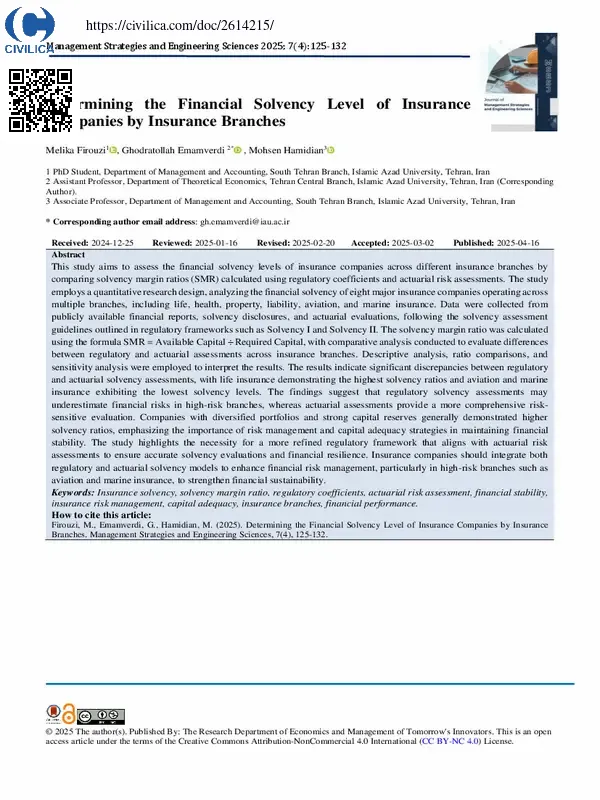
Determining the Financial Solvency Level of Insurance Companies by Insurance Branches
سال انتشار: 1404
نوع سند: مقاله ژورنالی
زبان: انگلیسی
مشاهده: 7
فایل این مقاله در 8 صفحه با فرمت PDF قابل دریافت می باشد
- صدور گواهی نمایه سازی
- من نویسنده این مقاله هستم
استخراج به نرم افزارهای پژوهشی:
شناسه ملی سند علمی:
JR_MSESJ-7-4_013
تاریخ نمایه سازی: 5 خرداد 1405
چکیده مقاله:
This study aims to assess the financial solvency levels of insurance companies across different insurance branches by comparing solvency margin ratios (SMR) calculated using regulatory coefficients and actuarial risk assessments. The study employs a quantitative research design, analyzing the financial solvency of eight major insurance companies operating across multiple branches, including life, health, property, liability, aviation, and marine insurance. Data were collected from publicly available financial reports, solvency disclosures, and actuarial evaluations, following the solvency assessment guidelines outlined in regulatory frameworks such as Solvency I and Solvency II. The solvency margin ratio was calculated using the formula SMR = Available Capital ÷ Required Capital, with comparative analysis conducted to evaluate differences between regulatory and actuarial assessments across insurance branches. Descriptive analysis, ratio comparisons, and sensitivity analysis were employed to interpret the results. The results indicate significant discrepancies between regulatory and actuarial solvency assessments, with life insurance demonstrating the highest solvency ratios and aviation and marine insurance exhibiting the lowest solvency levels. The findings suggest that regulatory solvency assessments may underestimate financial risks in high-risk branches, whereas actuarial assessments provide a more comprehensive risk-sensitive evaluation. Companies with diversified portfolios and strong capital reserves generally demonstrated higher solvency ratios, emphasizing the importance of risk management and capital adequacy strategies in maintaining financial stability. The study highlights the necessity for a more refined regulatory framework that aligns with actuarial risk assessments to ensure accurate solvency evaluations and financial resilience. Insurance companies should integrate both regulatory and actuarial solvency models to enhance financial risk management, particularly in high-risk branches such as aviation and marine insurance, to strengthen financial sustainability.This study aims to assess the financial solvency levels of insurance companies across different insurance branches by comparing solvency margin ratios (SMR) calculated using regulatory coefficients and actuarial risk assessments. The study employs a quantitative research design, analyzing the financial solvency of eight major insurance companies operating across multiple branches, including life, health, property, liability, aviation, and marine insurance. Data were collected from publicly available financial reports, solvency disclosures, and actuarial evaluations, following the solvency assessment guidelines outlined in regulatory frameworks such as Solvency I and Solvency II. The solvency margin ratio was calculated using the formula SMR = Available Capital ÷ Required Capital, with comparative analysis conducted to evaluate differences between regulatory and actuarial assessments across insurance branches. Descriptive analysis, ratio comparisons, and sensitivity analysis were employed to interpret the results. The results indicate significant discrepancies between regulatory and actuarial solvency assessments, with life insurance demonstrating the highest solvency ratios and aviation and marine insurance exhibiting the lowest solvency levels. The findings suggest that regulatory solvency assessments may underestimate financial risks in high-risk branches, whereas actuarial assessments provide a more comprehensive risk-sensitive evaluation. Companies with diversified portfolios and strong capital reserves generally demonstrated higher solvency ratios, emphasizing the importance of risk management and capital adequacy strategies in maintaining financial stability. The study highlights the necessity for a more refined regulatory framework that aligns with actuarial risk assessments to ensure accurate solvency evaluations and financial resilience. Insurance companies should integrate both regulatory and actuarial solvency models to enhance financial risk management, particularly in high-risk branches such as aviation and marine insurance, to strengthen financial sustainability.
کلیدواژه ها:
نویسندگان
Melika Firouzi
PhD Student, Department of Management and Accounting, South Tehran Branch, Islamic Azad University, Tehran, Iran
Ghodratollah Emamverdi
Assistant Professor, Department of Theoretical Economics, Tehran Central Branch, Islamic Azad University, Tehran, Iran
Mohsen Hamidian
Associate Professor, Department of Management and Accounting, South Tehran Branch, Islamic Azad University, Tehran, Iran
مراجع و منابع این مقاله:
لیست زیر مراجع و منابع استفاده شده در این مقاله را نمایش می دهد. این مراجع به صورت کاملا ماشینی و بر اساس هوش مصنوعی استخراج شده اند و لذا ممکن است دارای اشکالاتی باشند که به مرور زمان دقت استخراج این محتوا افزایش می یابد. مراجعی که مقالات مربوط به آنها در سیویلیکا نمایه شده و پیدا شده اند، به خود مقاله لینک شده اند :