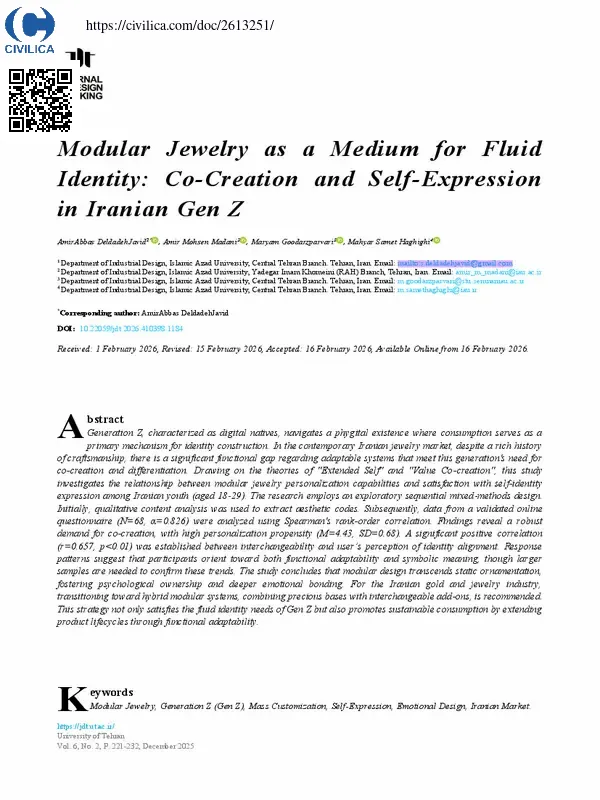
Modular Jewelry as a Medium for Fluid Identity: Co-Creation and Self-Expression in Iranian Gen Z
محل انتشار: دوفصلنامه تفکر طراحی، دوره: 6، شماره: 2
سال انتشار: 1404
نوع سند: مقاله ژورنالی
زبان: انگلیسی
مشاهده: 19
فایل این مقاله در 12 صفحه با فرمت PDF قابل دریافت می باشد
- صدور گواهی نمایه سازی
- من نویسنده این مقاله هستم
استخراج به نرم افزارهای پژوهشی:
شناسه ملی سند علمی:
JR_JJDT-6-2_002
تاریخ نمایه سازی: 4 خرداد 1405
چکیده مقاله:
Generation Z, characterized as digital natives, navigates a phygital existence where consumption serves as aprimary mechanism for identity construction. In the contemporary Iranian jewelry market, despite a rich historyof craftsmanship, there is a significant functional gap regarding adaptable systems that meet this generation's need forco-creation and differentiation. Drawing on the theories of "Extended Self" and "Value Co-creation", this studyinvestigates the relationship between modular jewelry personalization capabilities and satisfaction with self-identityexpression among Iranian youth (aged ۱۸-۲۹). The research employs an exploratory sequential mixed-methods design.Initially, qualitative content analysis was used to extract aesthetic codes. Subsequently, data from a validated onlinequestionnaire (N=۶۸, α=۰.۸۲۶) were analyzed using Spearman's rank-order correlation. Findings reveal a robustdemand for co-creation, with high personalization propensity (M=۴.۴۳, SD=۰.۶۸). A significant positive correlation(r=۰.۶۵۷, p<۰.۰۱) was established between interchangeability and user’s perception of identity alignment. Responsepatterns suggest that participants orient toward both functional adaptability and symbolic meaning, though largersamples are needed to confirm these trends. The study concludes that modular design transcends static ornamentation,fostering psychological ownership and deeper emotional bonding. For the Iranian gold and jewelry industry,transitioning toward hybrid modular systems, combining precious bases with interchangeable add-ons, is recommended.This strategy not only satisfies the fluid identity needs of Gen Z but also promotes sustainable consumption by extendingproduct lifecycles through functional adaptability.
کلیدواژه ها:
Modular Jewelry ، Generation Z (Gen Z) ، Mass Customization ، Self-expression ، Emotional design ، Iranian Market
نویسندگان
AmirAbbas DeldadehJavid
Department of Industrial Design, Islamic Azad University, Central Tehran Branch. Tehran, Iran
Amir Mohsen Madani
Department of Industrial Design, Islamic Azad University, Yadegar Imam Khomeini (RAH) Branch, Tehran, Iran
Maryam Goodarzparvari
Department of Industrial Design, Islamic Azad University, Central Tehran Branch. Tehran, Iran
Mahyar Samet Haghighi
Department of Industrial Design, Islamic Azad University, Central Tehran Branch. Tehran, Iran
مراجع و منابع این مقاله:
لیست زیر مراجع و منابع استفاده شده در این مقاله را نمایش می دهد. این مراجع به صورت کاملا ماشینی و بر اساس هوش مصنوعی استخراج شده اند و لذا ممکن است دارای اشکالاتی باشند که به مرور زمان دقت استخراج این محتوا افزایش می یابد. مراجعی که مقالات مربوط به آنها در سیویلیکا نمایه شده و پیدا شده اند، به خود مقاله لینک شده اند :