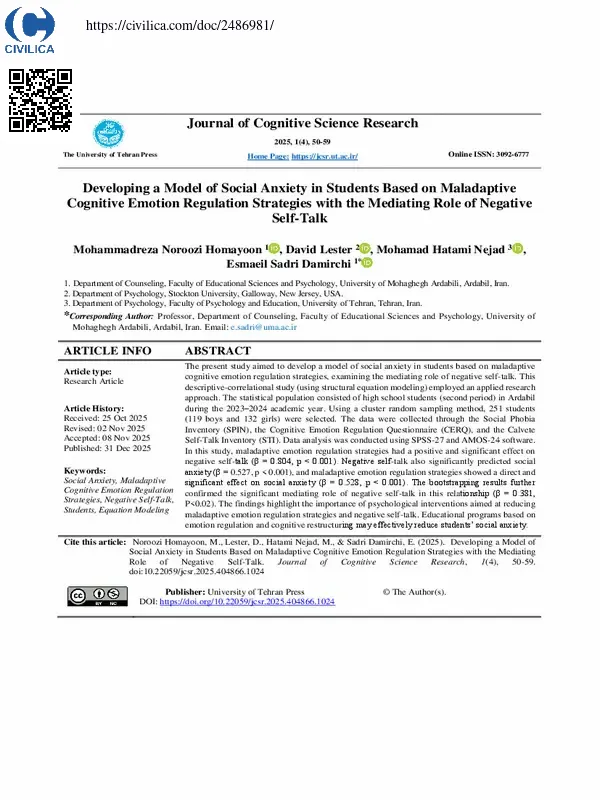
Developing a Model of Social Anxiety in Students Based on Maladaptive Cognitive Emotion Regulation Strategies with the Mediating Role of Negative Self-Talk
محل انتشار: فصلنامه تحقیقات علوم شناختی، دوره: 1، شماره: 4
سال انتشار: 1404
نوع سند: مقاله ژورنالی
زبان: انگلیسی
مشاهده: 2
فایل این مقاله در 10 صفحه با فرمت PDF قابل دریافت می باشد
- صدور گواهی نمایه سازی
- من نویسنده این مقاله هستم
استخراج به نرم افزارهای پژوهشی:
شناسه ملی سند علمی:
JR_JCSRH-1-4_004
تاریخ نمایه سازی: 7 بهمن 1404
چکیده مقاله:
The present study aimed to develop a model of social anxiety in students based on maladaptive cognitive emotion regulation strategies, examining the mediating role of negative self-talk. This descriptive-correlational study (using structural equation modeling) employed an applied research approach. The statistical population consisted of high school students (second period) in Ardabil during the ۲۰۲۳–۲۰۲۴ academic year. Using a cluster random sampling method, ۲۵۱ students (۱۱۹ boys and ۱۳۲ girls) were selected. The data were collected through the Social Phobia Inventory (SPIN), the Cognitive Emotion Regulation Questionnaire (CERQ), and the Calvete Self-Talk Inventory (STI). Data analysis was conducted using SPSS-۲۷ and AMOS-۲۴ software. Maladaptive cognitive emotion regulation strategies were found to be positively and significantly related to social anxiety, both directly and indirectly through negative self-talk. Negative self-talk played a significant mediating role in this relationship. The findings highlight the importance of psychological interventions aimed at reducing maladaptive emotion regulation strategies and negative self-talk. Educational programs based on emotion regulation and cognitive restructuring may effectively reduce students’ social anxiety.
کلیدواژه ها:
social anxiety ، Maladaptive Cognitive Emotion Regulation Strategies ، Negative Self-Talk ، students ، equation modeling
نویسندگان
Mohammadreza Noroozi Homayoon
Department of Counseling, Faculty of Educational Sciences and Psychology, University of Mohaghegh Ardabili, Ardabil, Iran.
David Lester
Department of Psychology, Stockton University, Galloway, New Jersey, USA.
Mohammad Hatami Nejad
Department of Psychology, Faculty of Psychology and Education, University of Tehran, Tehran, Iran.
Esmaeil Sadri Damirchi
Department of Counseling, Faculty of Educational Sciences and Psychology, University of Mohaghegh Ardabili, Ardabil, Iran.
مراجع و منابع این مقاله:
لیست زیر مراجع و منابع استفاده شده در این مقاله را نمایش می دهد. این مراجع به صورت کاملا ماشینی و بر اساس هوش مصنوعی استخراج شده اند و لذا ممکن است دارای اشکالاتی باشند که به مرور زمان دقت استخراج این محتوا افزایش می یابد. مراجعی که مقالات مربوط به آنها در سیویلیکا نمایه شده و پیدا شده اند، به خود مقاله لینک شده اند :