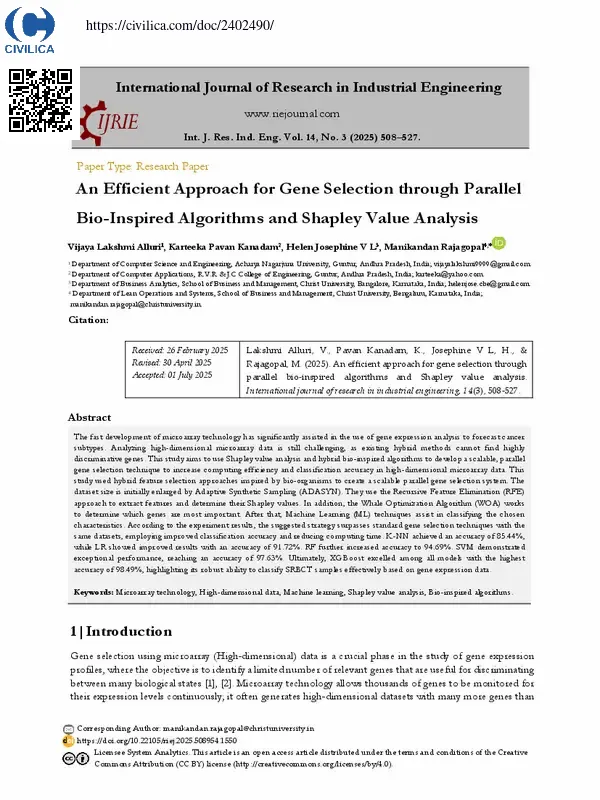
An efficient approach for gene selection through parallel bio-inspired algorithms and Shapley value analysis
سال انتشار: 1404
نوع سند: مقاله ژورنالی
زبان: انگلیسی
مشاهده: 154
فایل این مقاله در 20 صفحه با فرمت PDF قابل دریافت می باشد
- صدور گواهی نمایه سازی
- من نویسنده این مقاله هستم
استخراج به نرم افزارهای پژوهشی:
شناسه ملی سند علمی:
JR_RIEJ-14-3_006
تاریخ نمایه سازی: 27 مهر 1404
چکیده مقاله:
The fast development of microarray technology has significantly assisted in the use of gene expression analysis to forecast cancer subtypes. Analyzing high-dimensional microarray data is still challenging, as existing hybrid methods cannot find highly discriminative genes. This study aims to use Shapley value analysis and hybrid bio-inspired algorithms to develop a scalable, parallel gene selection technique to increase computing efficiency and classification accuracy in high-dimensional microarray data. This study used hybrid feature selection approaches inspired by bio-organisms to create a scalable parallel gene selection system. The dataset size is initially enlarged by Adaptive Synthetic Sampling (ADASYN). They use the Recursive Feature Elimination (RFE) approach to extract features and determine their Shapley values. In addition, the Whale Optimization Algorithm (WOA) works to determine which genes are most important. After that, Machine Learning (ML) techniques assist in classifying the chosen characteristics. According to the experiment results, the suggested strategy surpasses standard gene selection techniques with the same datasets, employing improved classification accuracy and reducing computing time. K-NN achieved an accuracy of ۸۵.۴۴%, while LR showed improved results with an accuracy of ۹۱.۷۲%. RF further increased accuracy to ۹۴.۶۹%. SVM demonstrated exceptional performance, reaching an accuracy of ۹۷.۶۳%. Ultimately, XGBoost excelled among all models with the highest accuracy of ۹۸.۴۹%, highlighting its robust ability to classify SRBCT samples effectively based on gene expression data.
کلیدواژه ها:
نویسندگان
Vijaya Lakshmi Alluri
Department of Computer Science and Engineering, Acharya Nagarjuna University, Guntur, Andhra Pradesh, India.
Karteeka Pavan Kanadam
Department of Computer Applications, R.V.R & J.C College of Engineering, Guntur, Andhra Pradesh, India.
Helen Josephine V L
Department of Business Analytics, School of Business and Management, Christ University, Bangalore, Karnataka, India.
Manikandan Rajagopal
Department of Lean Operations and Systems, School of Business and Management, Christ University, Bengaluru, Karnataka, India.
مراجع و منابع این مقاله:
لیست زیر مراجع و منابع استفاده شده در این مقاله را نمایش می دهد. این مراجع به صورت کاملا ماشینی و بر اساس هوش مصنوعی استخراج شده اند و لذا ممکن است دارای اشکالاتی باشند که به مرور زمان دقت استخراج این محتوا افزایش می یابد. مراجعی که مقالات مربوط به آنها در سیویلیکا نمایه شده و پیدا شده اند، به خود مقاله لینک شده اند :