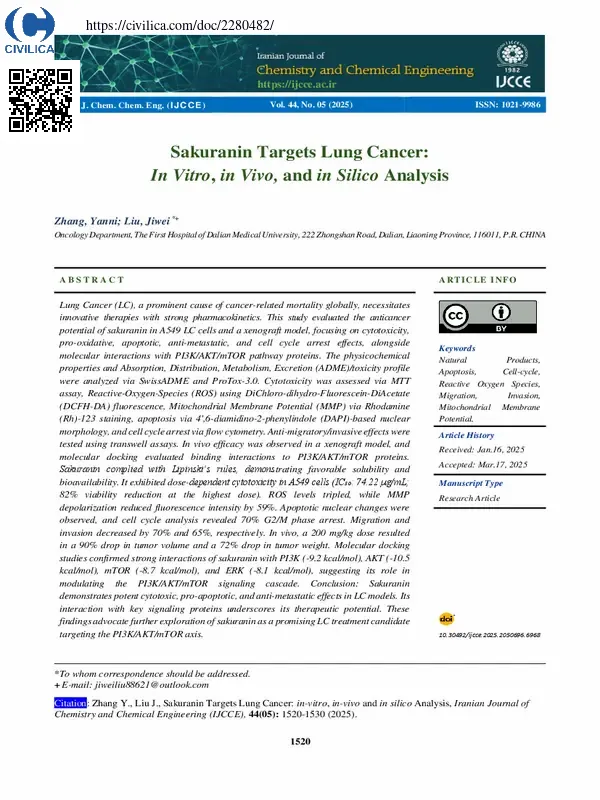
Sakuranin Targets Lung Cancer: In Vitro, in Vivo, and in Silico Analysis
سال انتشار: 1404
نوع سند: مقاله ژورنالی
زبان: انگلیسی
مشاهده: 167
فایل این مقاله در 11 صفحه با فرمت PDF قابل دریافت می باشد
- صدور گواهی نمایه سازی
- من نویسنده این مقاله هستم
استخراج به نرم افزارهای پژوهشی:
شناسه ملی سند علمی:
JR_IJCCE-44-5_017
تاریخ نمایه سازی: 16 خرداد 1404
چکیده مقاله:
Lung Cancer (LC), a prominent cause of cancer-related mortality globally, necessitates innovative therapies with strong pharmacokinetics. This study evaluated the anticancer potential of sakuranin in A۵۴۹ LC cells and a xenograft model, focusing on cytotoxicity, pro-oxidative, apoptotic, anti-metastatic, and cell cycle arrest effects, alongside molecular interactions with PI۳K/AKT/mTOR pathway proteins. The physicochemical properties and Absorption, Distribution, Metabolism, Excretion (ADME)/toxicity profile were analyzed via SwissADME and ProTox-۳.۰. Cytotoxicity was assessed via MTT assay, Reactive-Oxygen-Species (ROS) using DiChloro-dihydro-Fluorescein-DiAcetate (DCFH-DA) fluorescence, Mitochondrial Membrane Potential (MMP) via Rhodamine (Rh)-۱۲۳ staining, apoptosis via ۴',۶-diamidino-۲-phenylindole (DAPI)-based nuclear morphology, and cell cycle arrest via flow cytometry. Anti-migratory/invasive effects were tested using transwell assays. In vivo efficacy was observed in a xenograft model, and molecular docking evaluated binding interactions to PI۳K/AKT/mTOR proteins. Sakuranin complied with Lipinski’s rules, demonstrating favorable solubility and bioavailability. It exhibited dose-dependent cytotoxicity in A۵۴۹ cells (IC₅₀: ۷۴.۲۲ µg/mL; ۸۲% viability reduction at the highest dose). ROS levels tripled, while MMP depolarization reduced fluorescence intensity by ۵۹%. Apoptotic nuclear changes were observed, and cell cycle analysis revealed ۷۰% G۲/M phase arrest. Migration and invasion decreased by ۷۰% and ۶۵%, respectively. In vivo, a ۲۰۰ mg/kg dose resulted in a ۹۰% drop in tumor volume and a ۷۲% drop in tumor weight. Molecular docking studies confirmed strong interactions of sakuranin with PI۳K (-۹.۲ kcal/mol), AKT (-۱۰.۵ kcal/mol), mTOR (-۸.۷ kcal/mol), and ERK (-۸.۱ kcal/mol), suggesting its role in modulating the PI۳K/AKT/mTOR signaling cascade. Conclusion: Sakuranin demonstrates potent cytotoxic, pro-apoptotic, and anti-metastatic effects in LC models. Its interaction with key signaling proteins underscores its therapeutic potential. These findings advocate further exploration of sakuranin as a promising LC treatment candidate targeting the PI۳K/AKT/mTOR axis.
کلیدواژه ها:
نویسندگان
Yanni Zhang
Oncology Department, The First Hospital of Dalian Medical University, ۲۲۲ Zhongshan Road, Dalian, Liaoning Province, ۱۱۶۰۱۱, P.R. CHINA
Jiwei Liu
Oncology Department, The First Hospital of Dalian Medical University, ۲۲۲ Zhongshan Road, Dalian, Liaoning Province, ۱۱۶۰۱۱, P.R. CHINA
مراجع و منابع این مقاله:
لیست زیر مراجع و منابع استفاده شده در این مقاله را نمایش می دهد. این مراجع به صورت کاملا ماشینی و بر اساس هوش مصنوعی استخراج شده اند و لذا ممکن است دارای اشکالاتی باشند که به مرور زمان دقت استخراج این محتوا افزایش می یابد. مراجعی که مقالات مربوط به آنها در سیویلیکا نمایه شده و پیدا شده اند، به خود مقاله لینک شده اند :