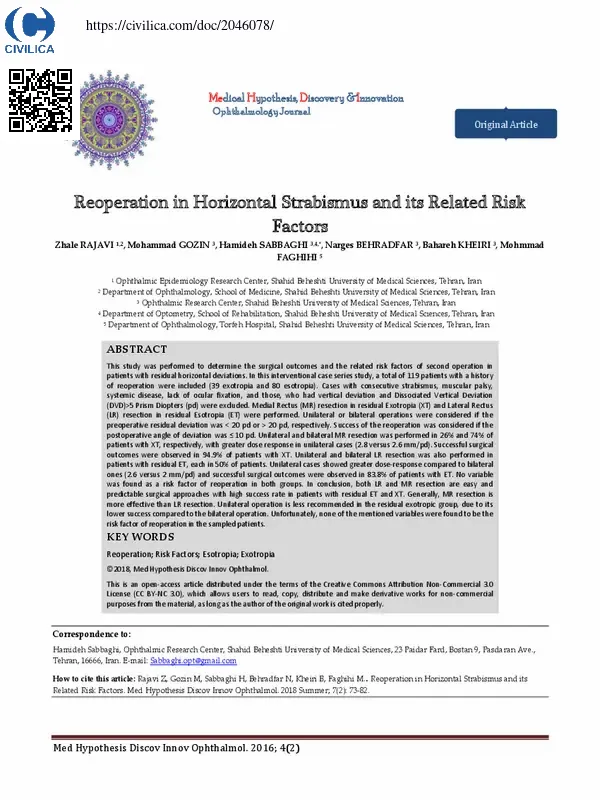
Reoperation in Horizontal Strabismus and its Related Risk Factors
سال انتشار: 1397
نوع سند: مقاله ژورنالی
زبان: انگلیسی
مشاهده: 158
فایل این مقاله در 10 صفحه با فرمت PDF قابل دریافت می باشد
- صدور گواهی نمایه سازی
- من نویسنده این مقاله هستم
استخراج به نرم افزارهای پژوهشی:
شناسه ملی سند علمی:
JR_MEOP-7-2_005
تاریخ نمایه سازی: 16 مرداد 1403
چکیده مقاله:
Abstract This study was performed to determine the surgical outcomes and the related risk factors of second operation in patients with residual horizontal deviations. In this interventional case series study, a total of ۱۱۹ patients with a history of reoperation were included (۳۹ exotropia and ۸۰ esotropia). Cases with consecutive strabismus, muscular palsy, systemic disease, lack of ocular fixation, and those, who had vertical deviation and Dissociated Vertical Deviation (DVD)>۵ Prism Diopters (pd) were excluded. Medial Rectus (MR) resection in residual Exotropia (XT) and Lateral Rectus (LR) resection in residual Esotropia (ET) were performed. Unilateral or bilateral operations were considered if the preoperative residual deviation was < ۲۰ pd or > ۲۰ pd, respectively. Success of the reoperation was considered if the postoperative angle of deviation was ≤ ۱۰ pd. Unilateral and bilateral MR resection was performed in ۲۶% and ۷۴% of patients with XT, respectively, with greater dose response in unilateral cases (۲.۸ versus ۲.۶ mm/pd). Successful surgical outcomes were observed in ۹۴.۹% of patients with XT. Unilateral and bilateral LR resection was also performed in patients with residual ET, each in ۵۰% of patients. Unilateral cases showed greater dose-response compared to bilateral ones (۲.۶ versus ۲ mm/pd) and successful surgical outcomes were observed in ۸۳.۸% of patients with ET. No variable was found as a risk factor of reoperation in both groups. In conclusion, both LR and MR resection are easy and predictable surgical approaches with high success rate in patients with residual ET and XT. Generally, MR resection is more effective than LR resection. Unilateral operation is less recommended in the residual exotropic group, due to its lower success compared to the bilateral operation. Unfortunately, none of the mentioned variables were found to be the risk factor of reoperation in the sampled patients.Â